TransitOps
Architecting A Unified Fleet Operations Platform
In the logistics and transportation sector, operational data is frequently fragmented. Organizations often rely on disparate systems to manage dispatch scheduling, vehicle maintenance, and financial reporting. This decentralization inevitably leads to data silos, compromised safety compliance, and costly state collisions—such as dispatching a vehicle that is concurrently flagged for critical engine repair.
To address these enterprise challenges, our team developed TransitOps: a centralized, real-time fleet operations platform. Engineered to unify dispatch, maintenance, and finance under a single, secure architecture, TransitOps provides a single source of truth for commercial fleet management.
Here is a technical overview of the architecture, the engineering challenges we addressed, and the business value delivered by the platform.
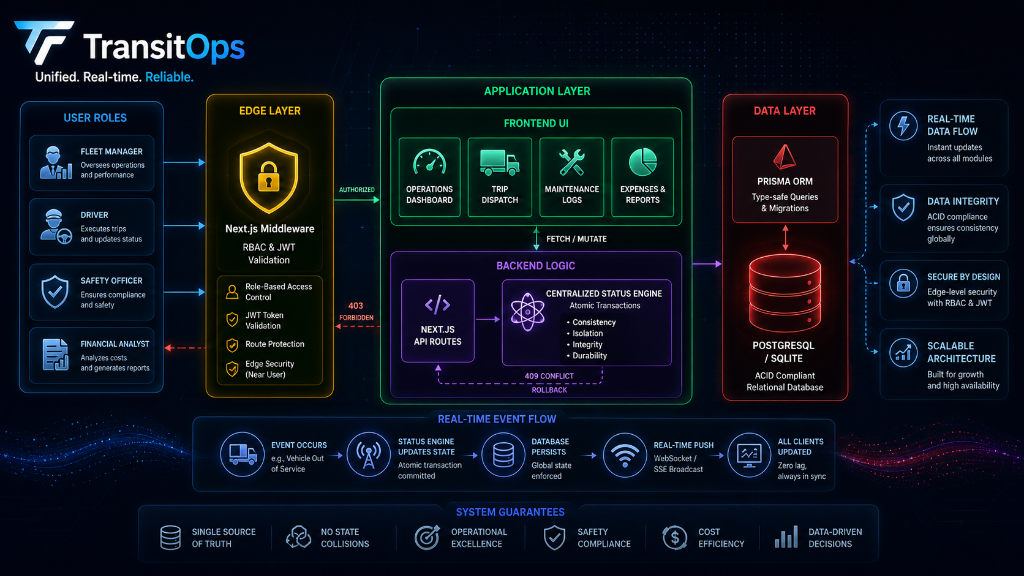
Enforcing Data Integrity with Edge-Level RBAC
In a production enterprise environment, data access must be strictly partitioned by organizational responsibility. A dispatcher requires visibility into driver availability, whereas a financial analyst requires access to toll expenses and operational ROI.
To guarantee data integrity, we implemented a strict Role-Based Access Control (RBAC) middleware at the network edge. The architecture natively supports four distinct operational roles:
- Fleet Manager: Oversees vehicle lifecycles and maintenance scheduling.
- Driver: Interacts with active trips and delivery routes.
- Safety Officer: Monitors driver compliance, license validity, and safety metrics.
- Financial Analyst: Tracks expenses, fuel logs, and fleet profitability.
The RBAC middleware actively intercepts and evaluates every request. If a user attempts a mutation outside their permitted scope—for example, a Fleet Manager attempting to write financial data—the system halts the request at the edge and returns a 403 Forbidden response. This guarantees security by default across both the UI and API layers.
TransitOps actively enforces role boundaries on every API mutation, ensuring strict data governance.
Eliminating State Collisions: The Centralized Status Engine
One of the most complex challenges in distributed fleet management is preventing concurrent state collisions. Without strict safeguards, a dispatcher could assign a truck to a route at the exact millisecond the maintenance department flags it as "In Shop."
To eliminate this risk, we decoupled our status logic from standard CRUD operations and engineered a Centralized Status Transition Engine. Every state change—whether transitioning a vehicle from Available to On Trip, or moving it to In Shop—is routed through this engine. The request is wrapped in an atomic database transaction and evaluated against a strict, pre-defined legal-transition matrix.
If an illegal or conflicting transition is attempted, the transaction immediately rolls back, yielding a 409 Conflict error to the client. This guarantees that the database never enters an invalid state.
// Centralized Status Transition Engine
export async function updateVehicleStatus(vehicleId: string, newStatus: string) {
  return await prisma.$transaction(async (tx) => {
    const vehicle = await tx.vehicle.findUnique({ where: { id: vehicleId } });

    // 1. Evaluate against Legal Transition Matrix
    if (!isValidTransition(vehicle.status, newStatus)) {
      throw new Error("409 Conflict: Illegal State Transition");
    }

    // 2. Atomically update the vehicle and push to Event Stream
    const updated = await tx.vehicle.update({
      where: { id: vehicleId },
      data: { status: newStatus }
    });

    await tx.eventLog.create({
      data: { type: 'STATE_CHANGE', vehicleId, newStatus }
    });

    return updated;
  });
}
The Status Engine safely manages vehicle transitions, completely eliminating the risk of cross-departmental scheduling conflicts.
Real-Time Telemetry: The Operations Dashboard
Actionable data is the cornerstone of efficient logistics. We engineered a live Operations Map and KPI Dashboard that serves as the command center for the platform.
Built on the Next.js 14 App Router and styled with a clean, high-contrast aesthetic using Tailwind CSS and shadcn/ui, the dashboard aggregates system-wide telemetry to deliver:
- Live Fleet Rosters: Immediate visibility into active, idle, and maintenance vehicle states.
- Financial Rollups: Real-time calculation of operational overhead (Fuel + Maintenance + General Expenses).
- Utilization Metrics: Instant visibility into fleet efficiency and driver allocation.
The Operations Dashboard provides real-time visibility into the logistical and financial heartbeat of the fleet.
Streamlining Profitability: Integrated Financial Tracking
Fleet profitability is heavily dependent on the meticulous tracking of operational overhead. We developed a dedicated Financial module enabling finance teams to log tolls, fuel fill-ups, and miscellaneous expenses against specific assets.
Because the backend services are tightly coupled, maintenance costs logged by the shop floor are immediately reflected in the vehicle's total operational overhead on the Financial dashboard. This eliminates the need for nightly batch jobs or manual data synchronization, providing leadership with instant financial clarity.
Every expenditure is tracked, categorized, and instantly factored into the asset's operational ROI.
Enterprise-Grade Security & Compliance
Given the sensitivity of driver records and financial data, TransitOps was architected to align with modern compliance standards:
- SOC 1 & SOC 2 Readiness: All financial actions and state transitions generate immutable audit logs. Credentials are cryptographically hashed using bcrypt, and user sessions are secured via stateless JWTs verified at the Edge.
- GDPR & Privacy: We enforce strict data isolation. Personally Identifiable Information (PII), such as driver license numbers and safety records, is restricted exclusively to the Safety Officer role, adhering to the principles of least-privilege access and data minimization.
The Technology Stack
TransitOps was engineered for high performance, scalability, and maintainability:
Frontend
Next.js 14 (App Router), React, Tailwind CSS, shadcn/ui
Backend
Next.js API Routes, Prisma ORM, PostgreSQL
Security
Edge-compatible JWT (jose), bcrypt, Stateless Sessions
Architecture
Atomic DB Transactions, Edge Middleware RBAC
Conclusion
Developing TransitOps required navigating the complexities of concurrent state management, strict security boundaries, and relational data architecture. The result is a robust platform that doesn't just display operational data, but actively enforces business logic to ensure fleet operations remain efficient, compliant, and safe.
To see the full application in action, watch our Odoo Hackathon 2026 demo:


