Archaeon
The Silent Killer of Engineering Velocity: Why We Built an Institutional Memory Layer
Every engineering leader knows the feeling. You hire a brilliant senior developer. They spend their first three months staring at a labyrinth of legacy code, reverse-engineering a mental model of the system. Eventually, they open a pull request proposing a massive refactor—say, migrating a synchronous payment flow to an asynchronous Kafka queue.
It's an elegant, scalable solution. It's also exactly the same solution your team tried, fought over, and ultimately rejected two years ago because of strict data compliance constraints.
But the new engineer didn't know that. Why? Because while code tells you what a system does, it completely fails to capture why it was built that way.
This is Institutional Amnesia, and it is the most expensive, invisible problem in software engineering. When your best engineers leave, the mental model of the architecture walks out the door with them. Documentation rots, Jira tickets disappear into the void, and Architecture Decision Records (ADRs) die the moment they are written because they are disconnected from the codebase where the work actually happens.
We decided to fix this. We built Archaeon: The Institutional Memory Layer for Software Architecture.
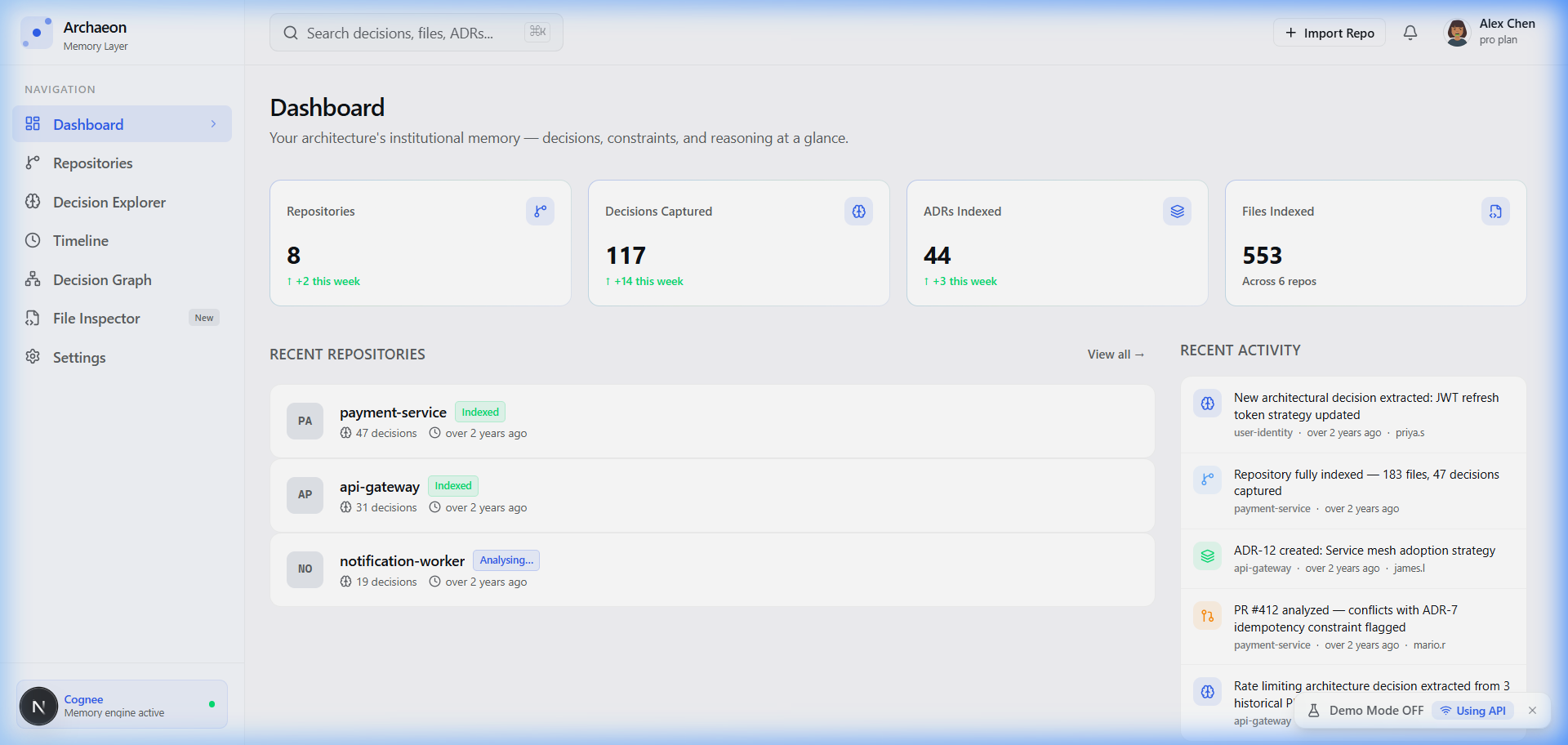
Moving Beyond Code Generation
The current wave of AI developer tools—like GitHub Copilot and Cursor—are incredible at generating code. But they only solve the problem of velocity. They help you build faster, but they don't ensure you are building the right thing.
LLMs can read a massive codebase and guess why a monolithic file exists, but they frequently hallucinate. They don't have access to the heated debates in old PR comments, the constraints discussed in Slack, or the rejected alternatives from two years ago.
Archaeon doesn't guess. It connects directly to your GitHub repository and automatically digests your history—commits, pull requests, and ADRs. It uses an AI extraction pipeline to identify the actual, historical architectural decisions, the authors who made them, the constraints that forced them, and the alternatives that were rejected.
But extracting the data is only half the battle. Storing it so it is actually useful requires a fundamentally new approach to AI memory.
The Core Engine: Why Cognee is the Secret Sauce
When building Archaeon, we faced a critical architectural choice of our own: How do you store and retrieve complex engineering decisions?
The industry default right now is RAG (Retrieval-Augmented Generation) powered by vector databases. But we quickly realized that RAG is fundamentally broken for architectural reasoning.
A vector search gives you "similar documents." But software architecture isn't about similarity; it's about relationships. You don't need a mathematically similar PR; you need to traverse a graph that says: "This file depends on this module because of this constraint, which was introduced to mitigate this incident, documented in this ADR."
That is why the beating heart of Archaeon is Cognee.
Cognee is an open-source framework designed to build deterministic, graph-based memory for AI applications. By pairing Cognee with Neo4j (a graph database), we moved beyond flat embeddings and built a living, traversable Knowledge Graph.
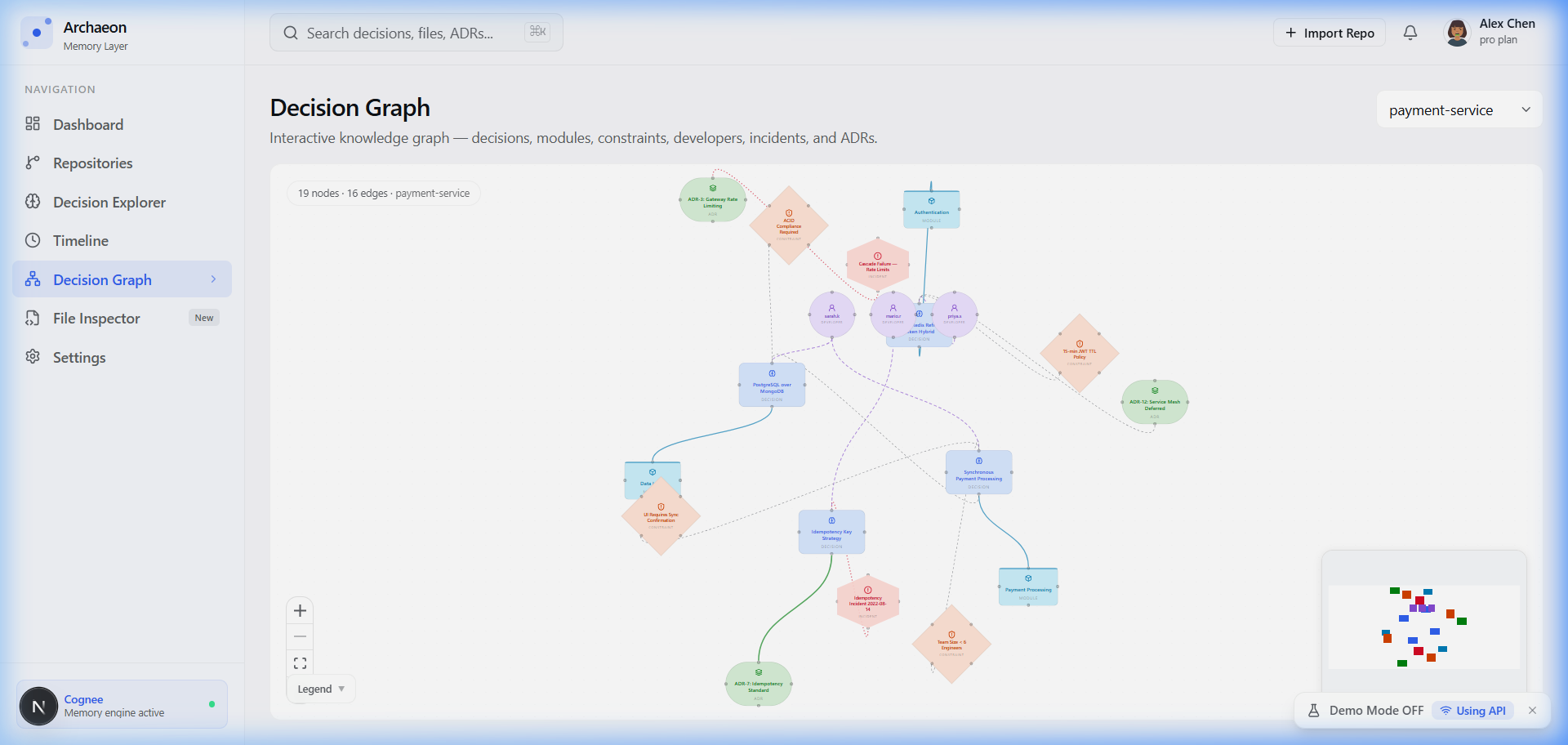
To see what this actually looks like under the hood, here is the raw JSON entity Cognee extracts and adds to the graph when you run remember():
{
  "entity_type": "architectural_decision",
  "id": "ADR-14",
  "author": "@asta-maxx",
  "decision": "Synchronous transaction flow",
  "rejected_alternatives": ["Asynchronous Kafka Queue"],
  "reasoning": "UI confirmation constraints require immediate response",
  "affected_modules": ["src/payments/transaction.ts"]
}
We utilized all four of Cognee's core memory primitives to make Archaeon work:
remember()– Indexing Reality: Whenever a new PR is merged or an ADR is approved, Archaeon doesn't just save text. Cognee parses the AI-extracted decision and maps the entities—linking the new choice to the specific developer, the affected modules, and the rejected alternatives.recall()– Context at the Point of Need: Documentation is useless if you have to go looking for it. When a developer opens a complex file in our dashboard (or via our VS Code extension), Cognee triggersrecall(). It traverses the graph and instantly surfaces the exact historical context for that specific file.improve()– Evolving the Graph: Software isn't static. When new constraints arrive, Cognee'simprove()primitive updates the existing knowledge graph, ensuring the system's memory gets smarter over time without creating conflicting duplicate records.forget()– Preserving History: When a decision is explicitly superseded by a new architecture, Cognee'sforget()primitive doesn't just delete the data. It archives the superseded decision, preserving the historical trail of how the system evolved, while keeping the active memory clean.
Without Cognee, Archaeon would degrade into a noisy, hallucination-prone search bar. With Cognee, it becomes a definitive, traversable brain of your engineering organization.
The "Wow" Moment: Memory in Action
What does it actually feel like to use an institutional memory layer?
Imagine a developer opens a pull request that touches your core idempotency layer. Before anyone even requests a review, Archaeon intercepts the PR. Using Cognee's graph traversal, it recognizes the files being touched, pulls the historical context, and leaves an automated comment:
"Warning: This PR appears to modify the synchronous transaction flow. Note that in March 2023, the team explicitly rejected asynchronous queues in this module due to UI confirmation constraints (See ADR-14). Are you sure you want to proceed?"
It's an active guardrail. It prevents the team from repeating the same debates, breaking forgotten invariants, and wasting weeks of engineering time.
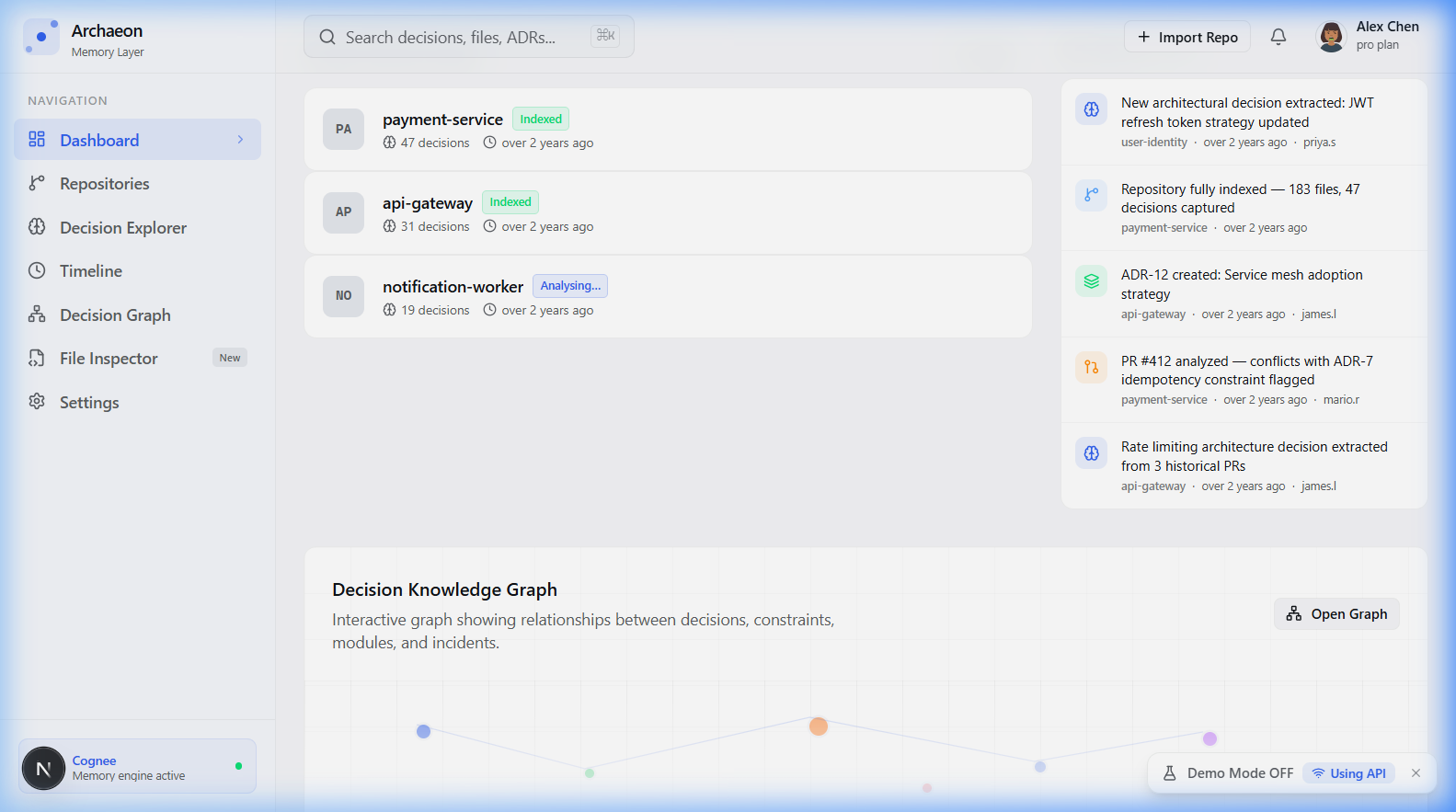
To see the full end-to-end workflow in action, watch our Cognee Hackathon submission video:
The Future of Architectural Intelligence
The next frontier of AI in software engineering isn't just writing code faster. It is giving AI the context to understand why the code exists in the first place.
By combining the extraction power of modern LLMs with the deterministic, graph-based memory of Cognee, Archaeon transforms dead history into a living, protective layer around your codebase.
Code tells you what. Archaeon remembers why.